Loading...
Style guides, outfit breakdowns, and deals — curated weekly for the modern Pakistani man.
12,000+ subscribers · No spam · Unsubscribe anytime
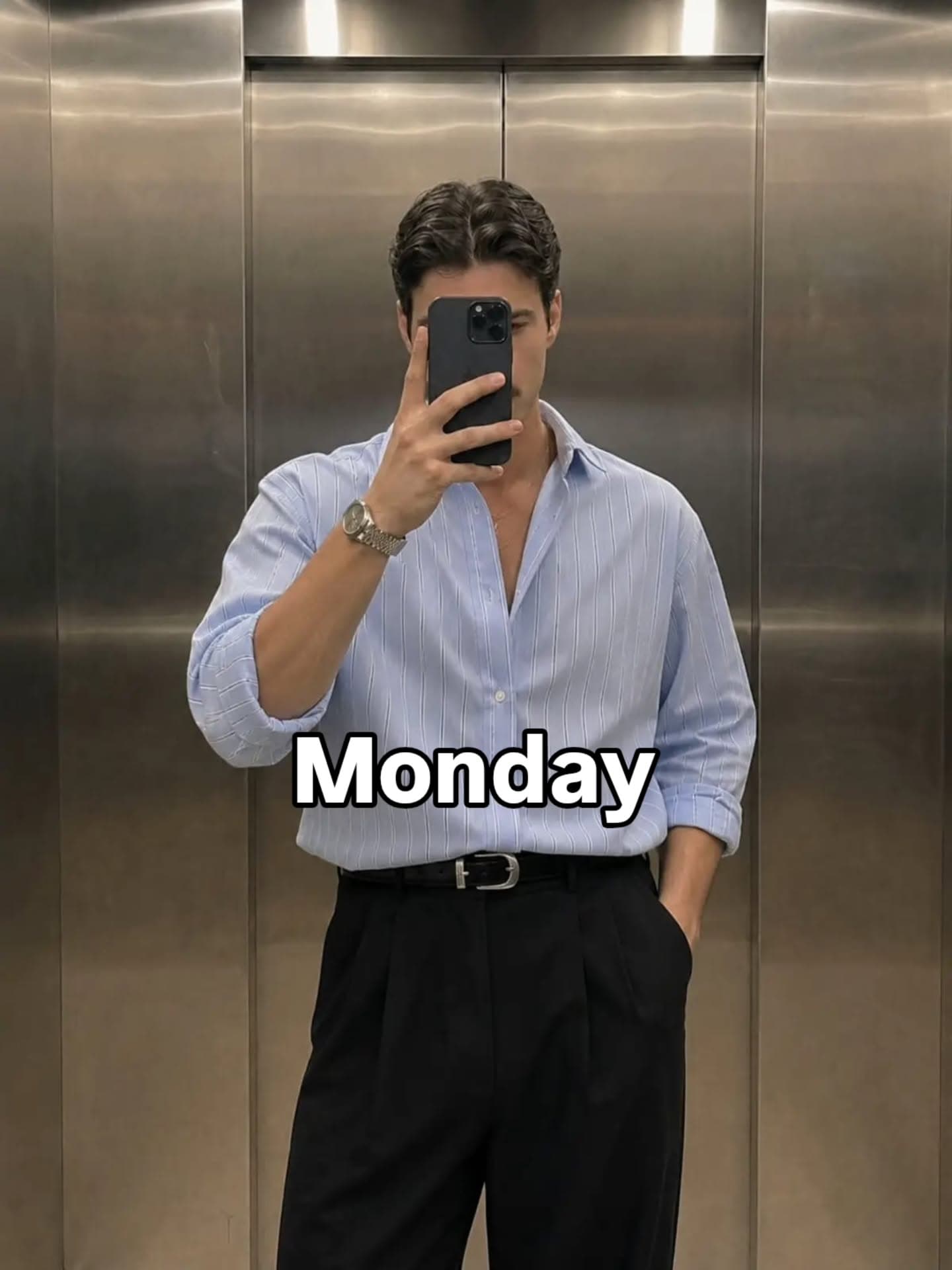
How to wear pleated trousers without looking dated. Get the rise, pleat direction and tuck right, then copy six pleated trousers outfits for men that work all week.
Most men avoid pleated trousers for one reason. They remember a bad pair — baggy, shapeless, sitting somewhere near the ribs, with two deep folds ballooning out over the hips. That memory is doing a lot of damage, because the modern version of this trouser is one of the easiest ways to look put together without buying anything expensive.
Here is the honest version. A pleat is not a style. A pleat is a piece of engineering. It adds fabric across the hip so the trouser can drape straight down instead of pulling tight across your thighs when you sit, walk or climb stairs. Done badly, it adds bulk. Done well, it adds room where you need it and a clean vertical line everywhere else.
This guide covers the fit rules that decide whether pleated trousers look sharp or sloppy, then walks through six real outfits built on the same trouser shape — one for each working day and one for the weekend. You can copy any of them tomorrow.
The pleated trousers that gave the style a bad name were built on a different set of proportions. Very wide leg, very long rise, heavy fabric, and pleats that opened outward toward the pockets. That combination pushed fabric away from the body and made the hip look wider than the shoulder — the opposite of what you want.
What changed is not the pleat. It is everything around it:
The result is a trouser that lengthens your leg, hides the waistband transition, and makes a plain shirt look intentional. It is genuinely one of the best-value fit upgrades available, and it works on most body types because the extra room sits where men usually need it.
Before any outfit, get these right. If a pair fails more than one of them, it is the wrong pair — not the wrong style.
Find the narrowest point of your torso, usually level with or just above your navel. The waistband should sit there and stay there without a belt doing all the work. If the trouser sits on your hips instead, the pleats open in the wrong place and pool fabric across your crotch. This single detail is what makes the leg look long.
Standing still, with your hands at your sides, the pleats should be closed. You should see two soft vertical creases, not two open gaps. If they gape while you are standing, the trouser is too tight through the hip and seat. Size up. Counterintuitive, but correct — gaping pleats are almost always a tightness problem, not a looseness problem.
Pleats that fold toward the fly (forward pleats) pull the eye inward and keep the silhouette narrow. Pleats that fold toward the pockets (reverse pleats) push fabric outward and can widen the hip. Both are legitimate, but if you are buying your first pair, forward pleats are more forgiving.
At the thigh you want a finger or two of space — enough to pinch a small amount of fabric, not a fistful. From knee to hem the line should be straight or very slightly tapered. Heavy taper fights the pleat and creates a triangle shape.
One light break or none at all. Pleated trousers already carry volume up top; a stack of extra fabric at the ankle doubles the visual weight. A hem that just touches the top of the shoe is the safest length. For the full breakdown of rise, seat, thigh and break, read how trousers should fit.
Pleated trousers are designed around a visible waistband. That is the whole point. The high waist is a design feature, and untucking your shirt hides it — which leaves you with a mystery silhouette and a hem that ends at an unflattering spot on the hip.
Every outfit below is tucked. Not loosely. Properly.
If your shirt bunches or blouses out over the waistband when you tuck it, that is a solvable problem, not a reason to give up. The military tuck takes about thirty seconds: pinch the excess fabric at each side seam, fold it backward, and lock it under the waistband as you fasten the trousers. You get a flat front and clean sides. For the general technique and when each tuck style applies, see how to tuck a shirt.
One more detail that carries every look below: a thin belt in a colour that agrees with the trouser. Not a wide statement belt. A narrow strip with a small metal buckle, doing its job quietly.
These six combinations share the same trouser architecture — high waist, closed pleats, straight leg, shirt tucked, thin belt, a watch on the wrist. Only the colour and the top layer change. That is the actual lesson: you are not building six outfits, you are building one system and rotating the inputs.
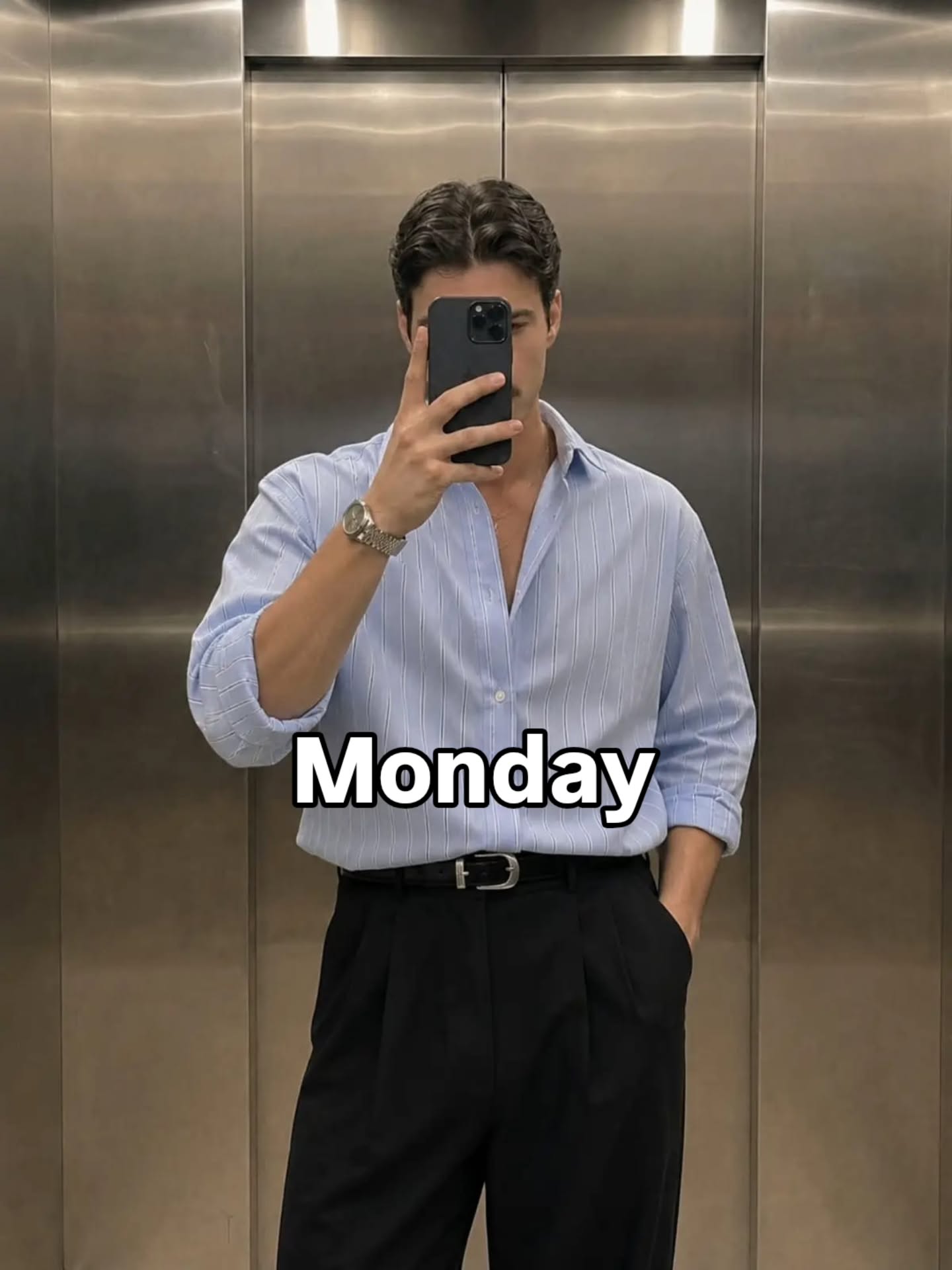
The easiest possible entry point. A light blue long-sleeve button-up, collar open at the neck, sleeves pushed up the forearm, tucked into black pleated trousers. Thin black leather belt with a small metal buckle. Silver watch.
Why it works: black trousers are the most forgiving pleated colour because black flattens visual bulk. If you are nervous about volume, start here. Light blue on top keeps it from reading as a uniform, and pushing the sleeves up stops a plain shirt from looking stiff.
The detail most men miss: push the sleeves, don't roll them into a neat cuff. A loose push up the forearm reads relaxed. A precise roll reads fussy. Aim for just below the elbow.
Shoe advice: black leather loafers or clean black derbies. Match the shoe to the belt, and keep the shoe low-profile so it does not compete with the trouser line.
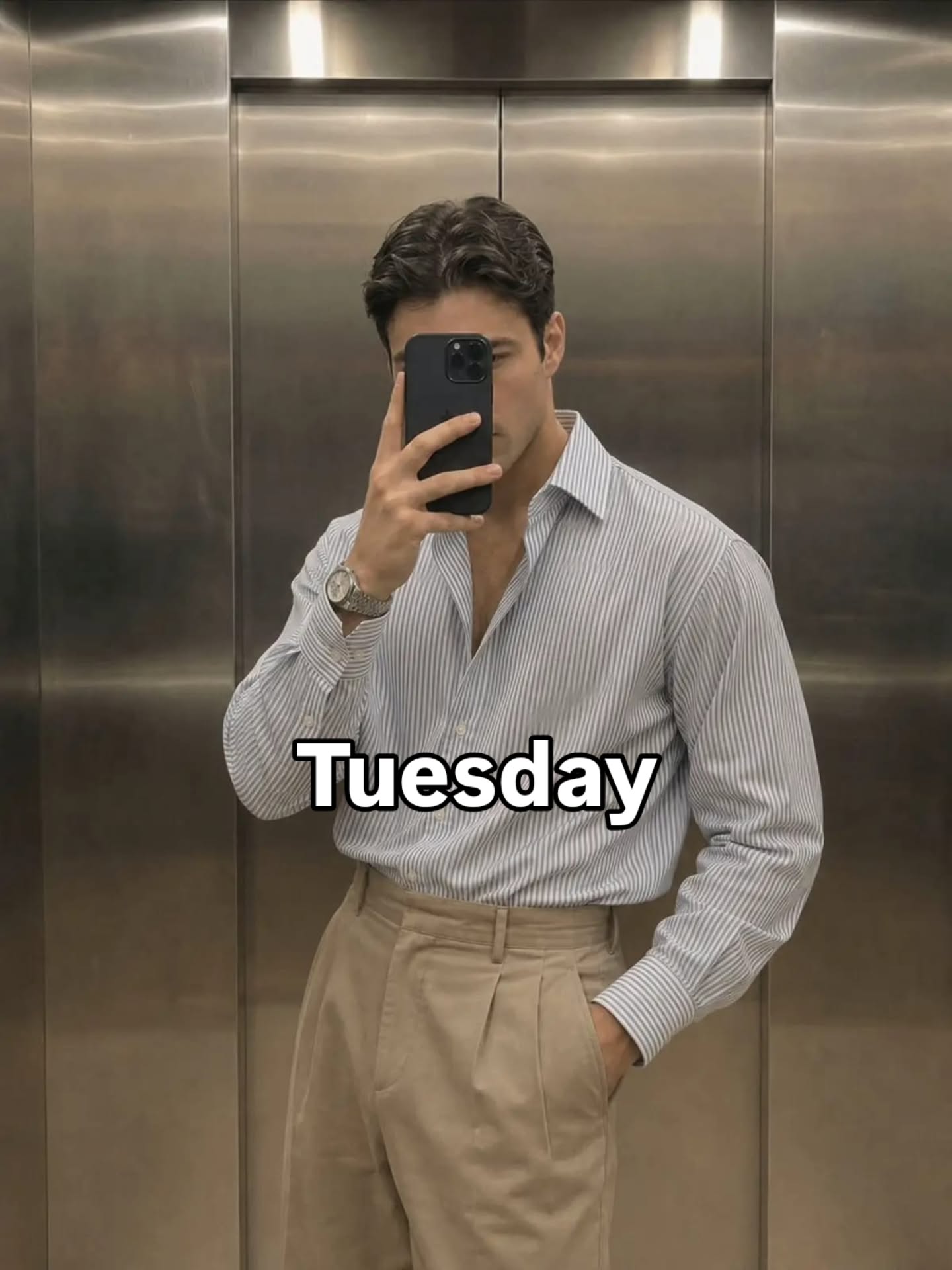
A light grey-and-white fine vertical stripe shirt, collar open, sleeves left down, tucked into light beige pleated trousers. Tan leather belt. Silver watch.
Why it works: fine vertical stripes reinforce the vertical line the pleats are already creating. The two work together instead of fighting. Beige trousers lift the whole outfit into warmer, softer territory, which suits daylight, warm weather, and anywhere a black trouser would feel severe.
The rule to take away: when the trouser is pale, the belt should be warm-toned, not black. Tan or mid-brown. A black belt against light beige creates a hard horizontal cut across the middle of the outfit and chops your height.
Keep the stripe fine. Bold stripes plus pleats plus a high waist is three loud ideas at once. If you want more on making stripes behave, read white striped shirt and black trousers.
Shoe advice: tan or light brown loafers, or white leather sneakers with a slim sole.
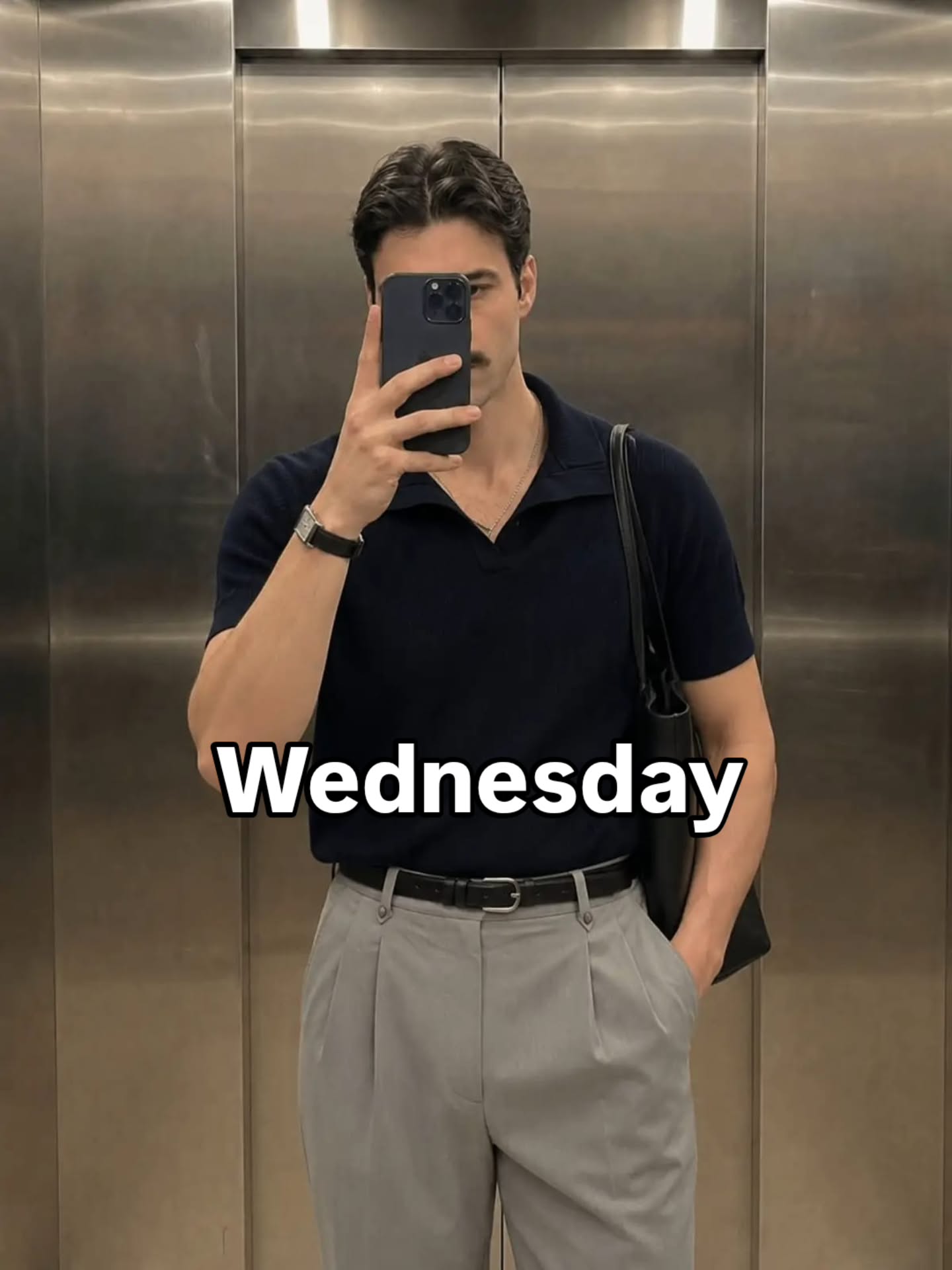
A dark navy short-sleeve knit polo with an open collar, tucked into light grey pleated trousers. Thin black belt with a silver buckle. Black-strap watch. A black shoulder bag strap crossing the chest.
Why it works: this is the answer to "I want to be comfortable but not look casual." A knit polo tucked into a high-waisted trouser sits exactly between a t-shirt and a dress shirt. The navy-over-grey pairing is cool-toned and quiet, so nothing shouts.
The critical detail: tucking a polo only works if the polo actually fits through the body. A loose polo tucked in creates a muffin of fabric above the belt. It needs to skim your torso. This is the single most common failure with tucked knitwear.
Note how the black accessories agree with each other — belt, watch strap, bag strap. Three black touchpoints spread across the outfit read as deliberate. Two blacks and one brown reads as an accident.
Shoe advice: black loafers or minimal black sneakers, staying in the same black family.
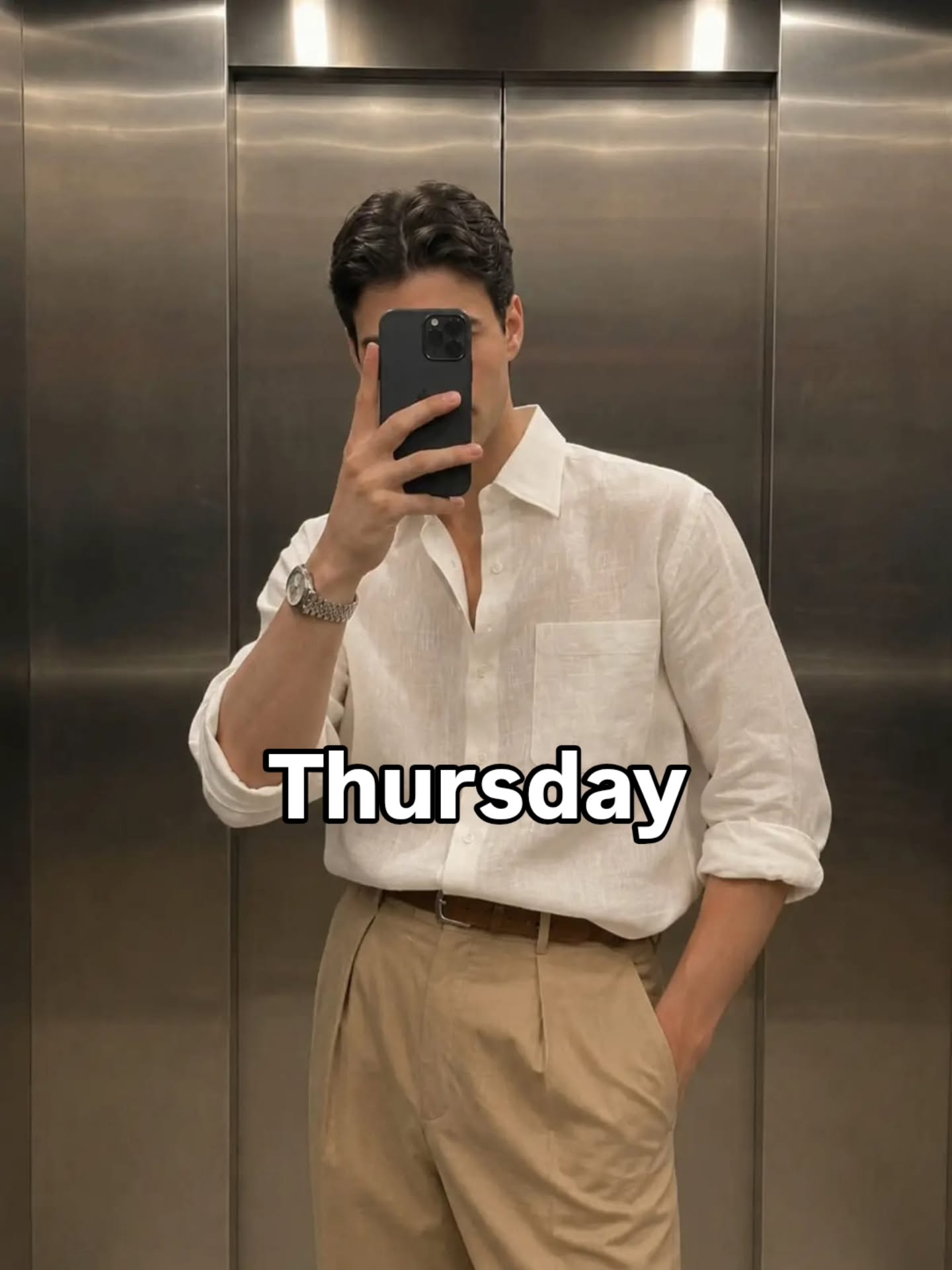
An off-white linen button-up, top buttons open into a soft V, sleeves rolled to mid-forearm, tucked into tan pleated trousers. Medium brown belt. Silver watch.
Why it works: this is a tonal outfit — cream and tan sit close together on the colour wheel, so the eye reads one continuous column rather than a top half and a bottom half. Tonal dressing is the fastest shortcut to looking expensive, and it costs nothing extra.
Linen is the ideal partner for pleats because it is light enough to fall. It also wrinkles, and that is fine — soft creases on linen look lived-in, not sloppy. Do not fight them.
The judgement call: open two buttons, not three. The soft V should end around the collarbone. Lower than that and the outfit changes character entirely.
Shoe advice: mid-brown leather loafers or suede. Because the trouser is warm-toned, brown footwear extends the tonal run all the way down.
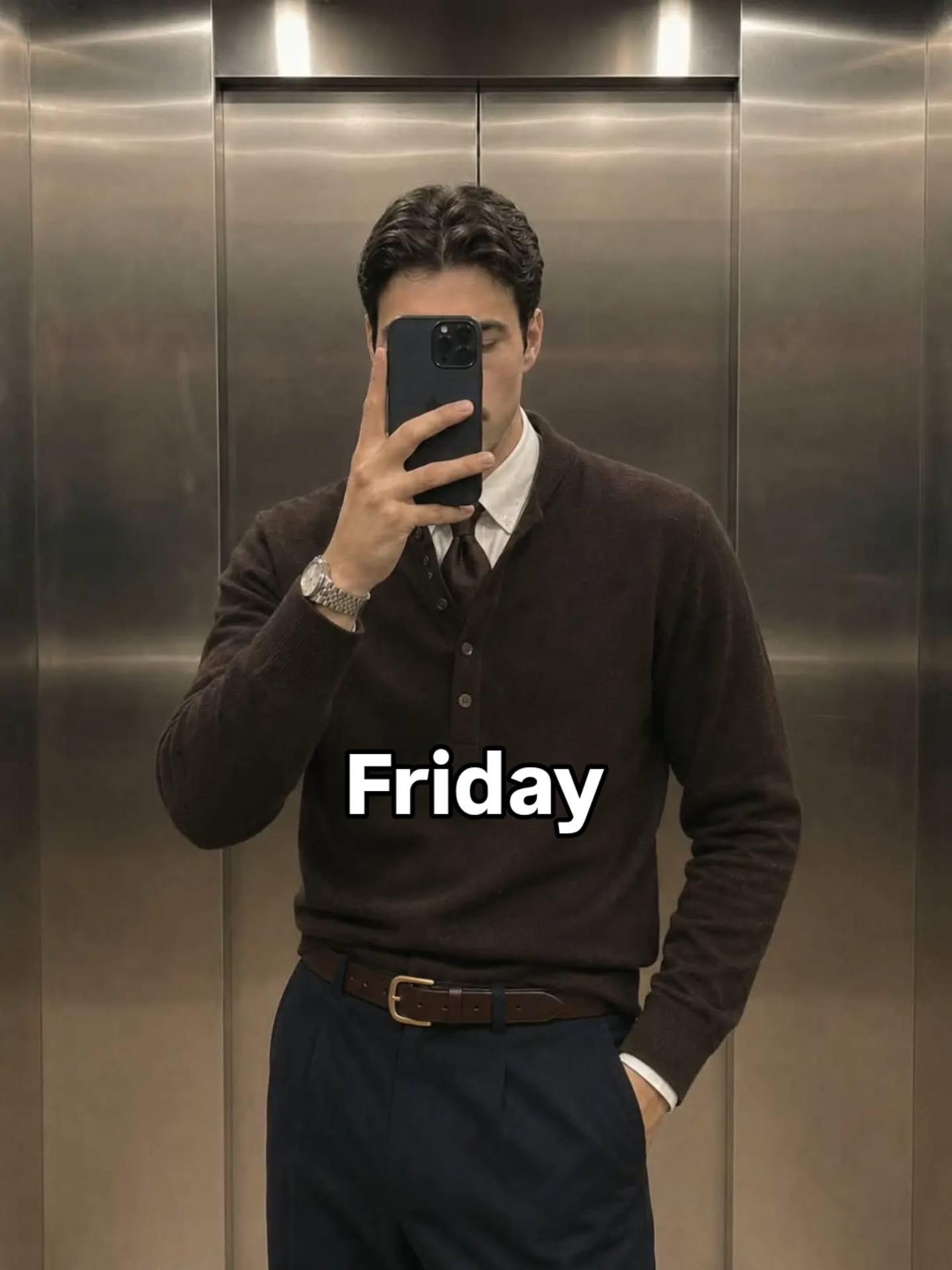
A dark brown knit cardigan worn over a crisp white collared dress shirt with a dark tie, paired with dark navy high-waisted trousers. Dark brown belt with a brass buckle. Silver watch.
Why it works: this is the most formal look in the set and the one that changes how people treat you in a room. Layering a knit over a shirt-and-tie is softer than a blazer but reads just as considered. Brown against navy is one of the most underused colour pairings in menswear — warm over cool, with neither one dominating.
The technical detail: the cardigan must be slim enough to sit close, and the tie must run underneath it, not over it. A bulky cardigan over a tie creates a lump at the chest. If your knit is thick, skip the tie.
The brass buckle here is doing quiet work. Warm brass against brown leather and brown knit continues the warm side of the outfit while the navy trouser anchors it.
Shoe advice: dark brown leather derbies or loafers, matched to the belt. This is the one look in the set where a sneaker would undercut everything above it.
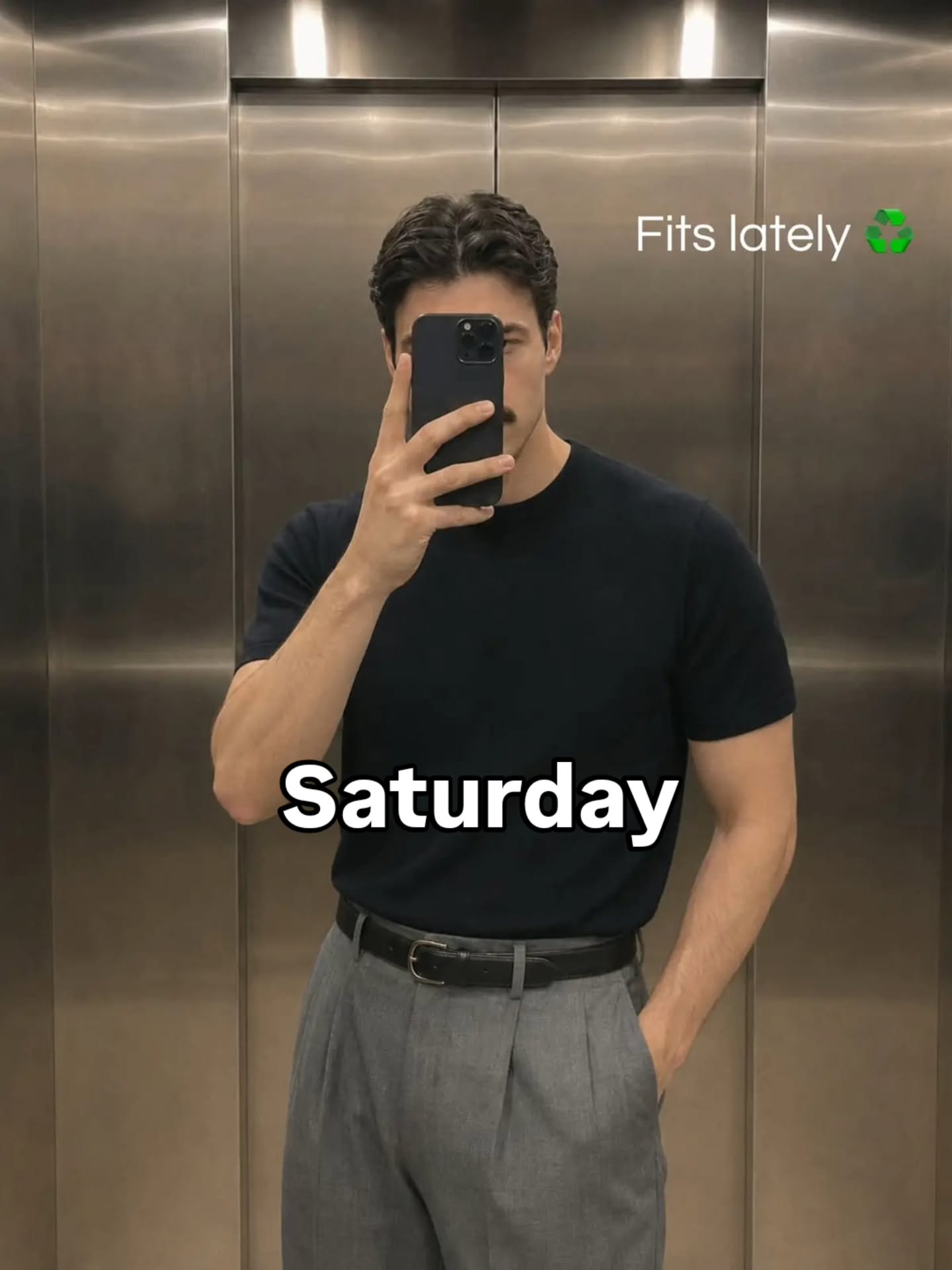
A plain black short-sleeve crewneck t-shirt, tucked into mid-grey pleated trousers. Thin black belt with a silver buckle. Watch.
Why it works: this is proof that pleated trousers are not office-only. A tucked plain tee against a tailored trouser is the whole modern casual formula — one relaxed piece, one structured piece. The tension between them is what makes it look considered instead of thrown together.
Requirements for the tee: plain, no graphic, and cut close enough to tuck cleanly. The shoulder seam should land at the edge of your shoulder, and the sleeve should end mid-bicep. A baggy tee tucked into a high waist just looks like laundry day.
Shoe advice: clean white leather sneakers or black loafers. Grey is neutral enough to take either.
Look at them together and the system is obvious:
| Element | What stayed the same |
|---|---|
| Trouser | High waist, closed pleats, straight leg, clean hem |
| Shirt/top | Always tucked, always fitted through the body |
| Belt | Thin, small buckle, matched to the trouser temperature |
| Watch | Present in every look, doing the finishing |
| Colour count | Two or three colours maximum, never four |
Six different impressions from one trouser shape. That is the actual value here — not the individual outfits, but the fact that a good pleated trouser in a neutral colour will carry a shirt, a polo, a tee, a linen button-up and a knit-and-tie without complaint.
If you own two pairs — one dark (black, charcoal or navy) and one light (beige, tan or light grey) — you can run this entire rotation. That two-trouser approach is covered in more depth in building a casual office week around two trousers.
Wearing them low. Pulling pleated trousers down to your hips because the high waist feels unfamiliar. It will feel odd for about three days. Wear them at the waist anyway.
Leaving the shirt untucked. You are paying for the high rise and then hiding it.
Buying too small. Gaping pleats mean the seat and hip are tight. Size up and get the waist taken in if needed — that is a cheap alteration.
Adding a wide belt. Wide belts create a horizontal band that fights the vertical line.
Too much taper. An aggressive taper turns a clean straight line into a cone.
Loud pattern on top. Pleats are already a detail. Pair them with plain or fine-patterned tops until you are confident.
Heavy, chunky shoes. A bulky sole under a straight-leg trouser makes the whole leg look bottom-heavy. Keep the shoe slim.
They are genuinely flexible, which is why they earn their place:
Pick one pair you already own — or one pair you buy — in a neutral colour. Wear it at your natural waist, with a tucked shirt and a thin belt, three days this week. Rotate the top only: shirt, polo, tee.
You will discover the same thing every man discovers with this trouser: nobody comments on the trousers. They just start describing you as someone who dresses well.
Are pleated trousers still in style? Yes. The modern version — natural-waist rise, one or two closed pleats, straight leg, light fabric — is a current staple. What went out of style was the very wide, very high, triple-pleated cut from decades ago, not the pleat itself.
Do pleated trousers make you look bigger? Only if they fit badly. Pleats that gape while you stand add bulk; pleats that lie flat add drape and actually create a longer, cleaner leg line. If yours look bulky, the seat and hip are too tight, not too loose.
Should the pleats face forward or toward the pockets? Forward-facing pleats fold toward the fly and keep the silhouette narrow, which is more forgiving for most men. Reverse pleats fold toward the pockets and add visible width at the hip. Start with forward pleats.
Do I have to tuck my shirt with pleated trousers? Practically speaking, yes. The high waistband is the design feature you are paying for, and an untucked shirt covers it. Untucked, the trouser loses most of its leg-lengthening effect.
What shoes go with pleated trousers? Slim, low-profile shoes: leather loafers, derbies, or clean minimal sneakers. Match leather shoes to your belt colour. Avoid chunky soles, which make the leg look bottom-heavy.
Can shorter men wear pleated trousers? Yes, and they often benefit most. The high waist raises the visual leg line, which lengthens the lower half. Keep the leg straight rather than wide, and hem with no break at all.
How many pairs do I need? Two. One dark for evenings and formal-leaning days, one light for daytime and warm weather. That covers a full week of rotation.
Save this guide and check your own trousers tonight — waist position, pleat lay, hem length. Fix those three things and every shirt you own starts working harder.
Build a reliable men’s wardrobe with 20 essential pieces: shirts, jeans, chinos, shoes, outerwear, accessories, and grooming basics.