Loading...
Style guides, outfit breakdowns, and deals — curated weekly for the modern Pakistani man.
12,000+ subscribers · No spam · Unsubscribe anytime
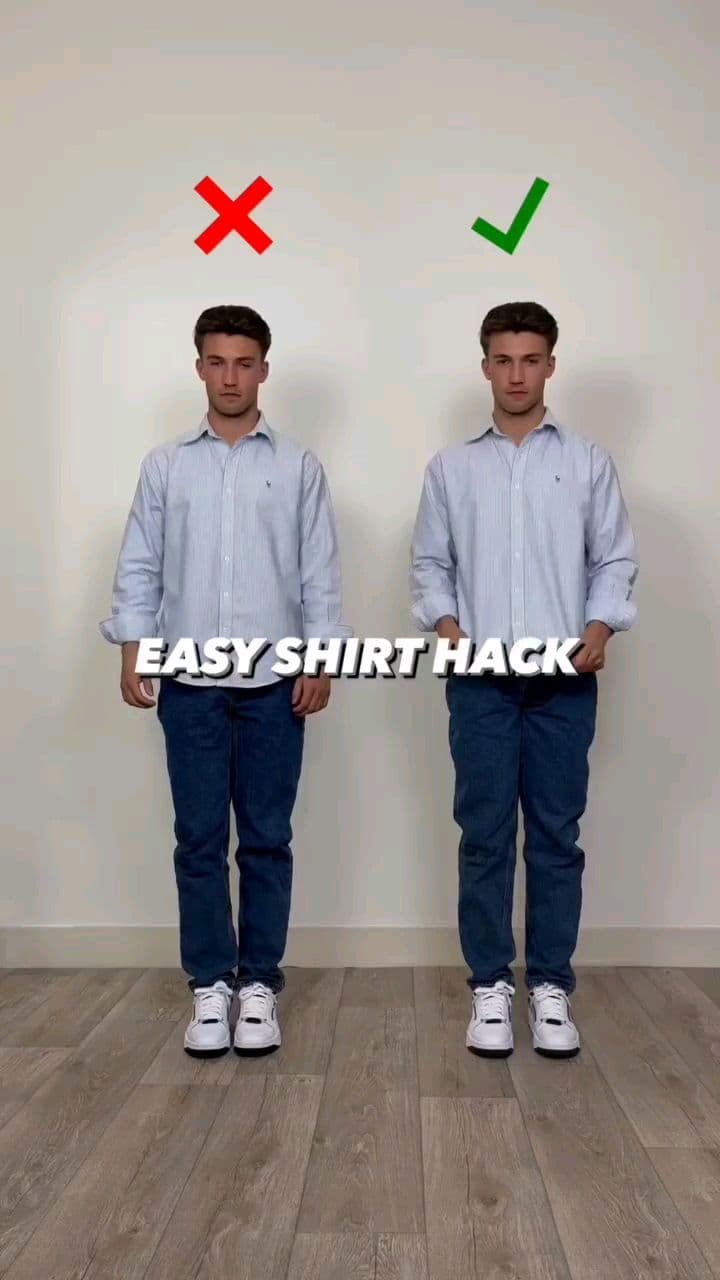
Learn how to tuck a shirt properly. The full tuck, half tuck, French tuck and military tuck explained, plus when to leave a shirt untucked.
Most men own a shirt that looks worse than it should. The colour is fine. The size is roughly right. But the moment it goes on, it hangs like a bedsheet, hides the waist, and makes the whole outfit look shapeless.
Nine times out of ten, the shirt is not the problem. The tuck is.
Tucking is the cheapest styling upgrade available to you. It costs nothing, takes four seconds, and changes where the eye lands on your body. Yet almost nobody was taught how to do it properly, so most men default to one of two extremes: everything untucked forever, or a full tuck that puffs out over the belt like a paper bag.
This guide fixes that. You will learn the four tucks worth knowing, how to make a tuck stay put, and — just as important — when to leave the shirt out entirely.
An outfit reads as a set of proportions before it reads as clothes. When someone looks at you, they are unconsciously finding your waistline, because that line splits your body into an upper and lower half. That split is what makes you look tall, balanced, and put together.
An untucked shirt erases that line. The fabric drops straight from your chest to your hip in one uninterrupted column, so the eye never finds a waist. The result is a body that reads as one long rectangle. Wide, flat, a little shorter than you actually are.
A tuck puts the waistline back. Instantly, you have a defined upper and lower half, your legs read longer, and your shoulders read wider by comparison. Nothing about your body changed. The information the outfit gives just got clearer.
This is why the same shirt and the same jeans can look sloppy in one photo and sharp in the next.
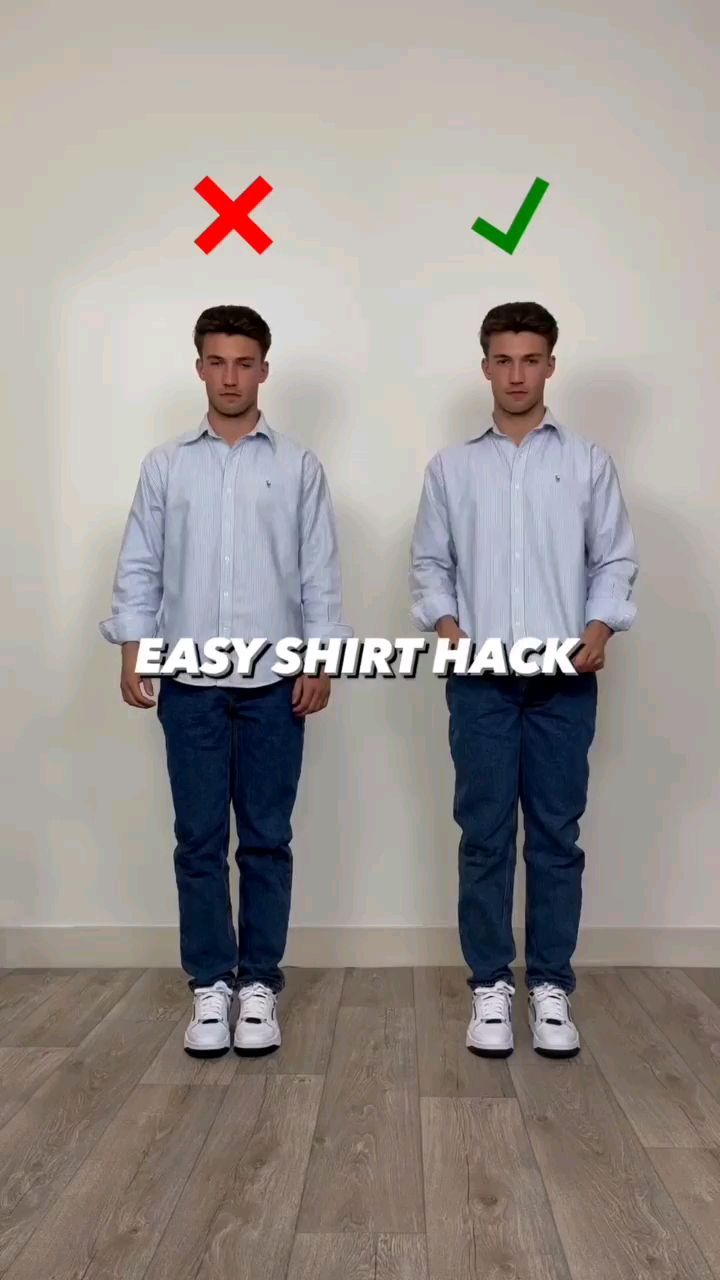
Look at the two versions above. Same man, same light blue button-down, same dark indigo jeans, same white sneakers. The only variable is what happens at the waist.
On the left, the shirt hangs loose and boxy. It falls in a straight line past the belt and covers the top of the jeans completely. The silhouette has no middle. On the right, he gathers the excess fabric at the side seam and brings it in at the waist. The moment that happens, the jeans become visible as a separate garment, the waistline appears, and the proportions resolve.
That is the entire lesson in one frame. The fix is not a new shirt. It is the four seconds you spend at the waist.
The whole shirt goes in, all the way around, front to back.
Use it when the situation has any formality: office, meetings, dinner with a dress code, weddings, anything with a jacket, anything with dress trousers. If you are wearing a belt you want people to see, you are wearing a full tuck.
The full tuck is also the one men get wrong most often, because a full tuck done badly is worse than no tuck at all. Fixes for that are in the next section.
The front of the shirt tucks in on one side only — usually the side your belt buckle sits toward. The rest hangs loose.
The half tuck is the casual workhorse. It gives you the waistline you need without the buttoned-up formality of a full tuck. It works with jeans, chinos, and casual trousers, and it is the right answer for most weekend and smart-casual situations.
The rule that keeps it from looking accidental: tuck a small, deliberate amount. Roughly a hand's width of fabric, on one side, pushed in cleanly. If you tuck too much, it looks like a full tuck that failed. If you tuck too little, it looks like the shirt caught on your pocket.
Only the very front centre of the shirt goes in, between the belt loops on either side of the buckle. Everything else stays out.
This is the lightest touch of the four. It hints at a waistline without committing to one, and it works especially well with a shirt worn open over a t-shirt, or with a slightly longer shirt that would otherwise cover too much of your trousers.
This is not a different look — it is the technique that makes a full tuck stay flat.
Tuck the shirt in fully. Then, with a hand on each side, find the excess fabric at your side seams, pull it backwards and flat against your body, and fold it toward your spine. Hold the folds in place, then fasten your trousers over them.
The result is a shirt with no billow at the front, no bunching over the belt, and a clean line from chest to waist. It is what the man in the photo above is doing with his hands: gathering the loose fabric at the side rather than letting it puff out at the front.
Learn this one and your full tucks will look twice as good with no extra effort.
Your shirt is too big. A tuck cannot rescue a shirt that is two sizes too wide, because all that extra fabric has to go somewhere and the only place it can go is around your waistband. If your tuck always billows, check the shirt before you blame the tuck. Our guide on how a shirt should fit covers the shoulder seam and body checks that matter.
Your shirt is too short. A shirt that barely reaches your hip will untuck itself the first time you raise your arm. Shirts made to be tucked have a longer, curved hem for exactly this reason. If the hem is straight and short, it was designed to be worn out.
You tucked standing still. Tuck, then move. Sit down, reach up, twist. A tuck that only survives a mirror is not a tuck.
Your trousers sit too low. If the waistband is riding down on your hips, the shirt has extra distance to travel and nothing holding it. Trousers that sit at your natural waist hold a tuck far better. This is one of the checks in our guide to how trousers should fit.
You skipped the side fold. This is the military tuck point above. Without it, the excess fabric has nowhere to go but forward, over your belt.
Tucking is not automatically better. Forcing a tuck on the wrong garment looks stiffer and more awkward than leaving it out.
Leave it untucked when:
The one situation with no ambiguity: if you are wearing a suit or a blazer over a dress shirt, the shirt is tucked. Always.
If you want a single sentence to carry around:
Formal or tailored, full tuck. Casual with jeans or chinos, half tuck. Straight hem or hip-length, leave it out.
That covers roughly ninety percent of the shirts you will put on this year.
Go to your wardrobe and pull out every button-up shirt you own. Look at two things on each one: the shape of the hem, and where it lands on your body.
Curved hem that drops below your hip — that shirt is a tucking shirt. Practise the military tuck on it once, in front of a mirror, and feel where the side folds go.
Straight hem that lands at your hip — that shirt is an untucked shirt. Stop fighting it.
Any shirt whose hem lands past your crotch and cannot be tucked cleanly is neither. That one is too big, and it is why your outfits have been looking shapeless.
Doing this once means you will never have to think about it again. You will just know, when you pick up a shirt, what it wants to do.
Save this for the next time you get dressed, and send it to the friend whose shirt is always hanging out.
Should I tuck my shirt in with jeans? Usually a half tuck, not a full tuck. Jeans are casual, so a full tuck can look overly formal unless you are pairing them with a blazer or dressier shoes. A half tuck gives you the waistline without the stiffness. See our guide on how jeans should fit for the fit checks that make this work.
How do I keep my shirt tucked in all day? Use the military tuck: fold the excess side fabric backwards toward your spine before fastening your trousers. Also make sure your trousers sit at your natural waist rather than low on your hips, and that your shirt has a long, curved hem. Those three things together solve most untucking problems.
Is the half tuck still in style? Yes, and it is more of a proportion technique than a trend. Any styling method that defines your waistline will keep working, because the reason it works is anatomical rather than fashionable.
Can I tuck a t-shirt? You can, but treat it as a deliberate choice rather than a default. A tucked plain tee works well with tailored trousers or a well-fitted pair of jeans and a belt. It looks off with baggy or low-slung trousers. Our smart casual guide covers where this sits.
How do I know if a shirt is meant to be tucked? Check the hem. A curved hem with a longer front and back "tail" is built for tucking. A straight hem cut level all the way around is built to be worn out. The garment tells you if you look at it.
Do I need a belt if my shirt is tucked? If you are wearing trousers with belt loops and your shirt is fully tucked, yes — an exposed waistband with visible empty loops looks unfinished. If the trousers have no loops, no belt is needed. Match the belt leather to your shoe leather. Our wardrobe essentials guide covers which belts to own.
Build a reliable men’s wardrobe with 20 essential pieces: shirts, jeans, chinos, shoes, outerwear, accessories, and grooming basics.